CS2 Cheapest Knife Trade Up Inputs 2026 — Fill Levels That Actually Profit
Getting a knife from a trade up contract in CS2 is the ultimate flex—and the ultimate math problem. If you search "cs2 cheapest knife trade up inputs 2026," you have already figured out the first step: you need ten skins of the right quality and float to spit out a Tier-3 knife from the Chroma, Spectrum, or Gamma finishers. The tricky part is finding those ten inputs without bleeding money before you even click "Exchange."
Most guides will tell you to just buy the cheapest Covert SMGs or pistols from the target collection. That advice is half true. The real skill is in identifying which skins have the tightest float cap alignment so you can use the cheapest possible wear while still hitting the knife's minimum float. Let's walk through the exact numbers for 2026, using real skin names, real float ranges, and a clear-eyed look at where you source those fillers.
Why Most Knife Trade Up Attempts Fail
Before you open your wallet, understand the two silent killers of knife trade ups: float miscalculation and lazy sourcing.
A trade up contract takes the average float of your ten input skins and rounds it to two decimal places, then uses that as the output float. Each knife has a minimum float—often 0.00 for Doppler/Gamma Doppler finishes, or 0.06 for Tiger Tooth. If your input average produces 0.057 but the knife minimum is 0.06, the contract simply fails. You lose the ten inputs.
The Float Cap Trap
Most Covert-grade skins in knife-eligible collections have a float cap of 0.75 or 0.80. That means you can find battlescarred copies for cheap. But the knife you want—say, a Bayonet | Gamma Doppler—has a max float of 0.08. If you feed the contract ten 0.70-float fillers, your average is 0.70, output is 0.70, and the contract fails because the knife can't exist above 0.08. You must calculate the maximum permissible average before buying a single skin.
Formula: Input Ave Float ≤ (Knife Max Float + (10 × 0.005)) / 10? No—the contract simply caps output at the knife's min/max range. The practical rule: your input average float must be equal to or lower than the knife's maximum float minus 0.02 to account for rounding spikes. For a 0.08-max knife, keep your input average below 0.065.
Cheapest Knife Trade Up Inputs by Collection (2026 Prices)
We focus on three collections where the cheapest Covert fillers overlap with high-value knife finishes. Prices reflect current Steam Community Market and CSFloat medians, with CSBoard acting as the benchmark for real-time P2P listings.
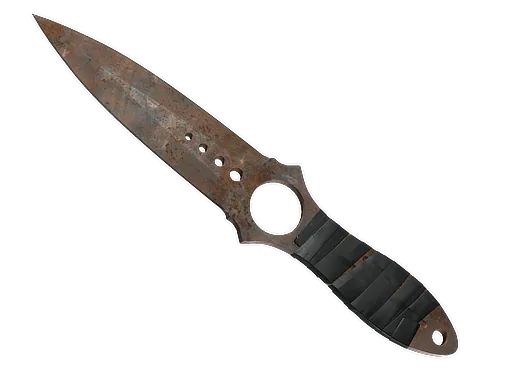
Chroma 2 / Chroma 3 — Target: Bayonet | Tiger Tooth (0.06 max)
The Bayonet | Tiger Tooth sits at 0.06-0.80 max float. Two cheap inputs dominate:
- MAC-10 | Neon Rider (Covert) — Float cap 0.75. Current cheapest battlescarred listings sit around $1.80-$2.20 per skin. You need ten copies, total $18-$22 before any fees.
- AK-47 | Point Disarray (Covert) — Float cap 0.80. Battlescarred copies hover near $3.50-$4.00 each.
For the Tiger Tooth, your input average must stay under 0.06. That means you cannot use battlescarred fillers. Field-Tested (0.20-0.35 average) gets borderline. Minimal Wear (0.10-0.15) works but kills the profit. The break-even point: if you can source Minimal Wear Neon Riders at $6-$7 each, ten pieces cost $60-$70, and a Bayonet Tiger Tooth sells for $250-$280 on CSBoard. That is a healthy margin, but only if every single float checks out.
Spectrum / Spectrum 2 — Target: M9 Bayonet | Tiger Tooth (0.06 max)
The M9 Tiger Tooth commands a higher premium, around $390-$430. The cheapest Covert fillers:
- P250 | Ripple (Covert) — Float cap 0.80. Battlescarred at $1.30-$1.80 each. Too high float for Tiger Tooth unless you mix in low-float copies.
- Desert Eagle | Oxide Blaze (Covert) — Float cap 0.80. Battlescarred near $2.50-$3.00.
To hit a 0.06 output, you need an average float of 0.06 or below across all ten inputs. That forces you toward Minimal Wear Ripples (0.08-0.15 float, costing $4-$5 each). Ten pieces = $40-$50 input cost for a $400 knife. The math works, but availability is thin. P2P marketplaces like CSBoard let you filter by exact float and seller, avoiding the "buy first, check float after" problem on bot-driven sites.
Gamma / Gamma 2 — Target: Karambit | Gamma Doppler (0.08 max)
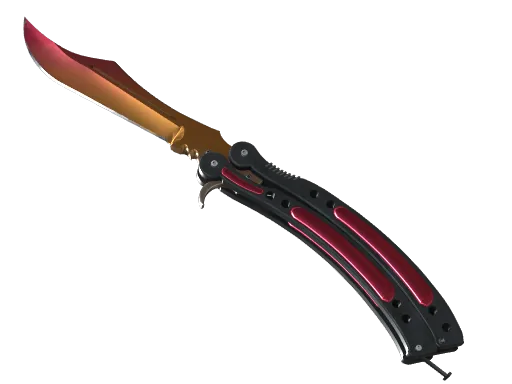
The Karambit Gamma Doppler Phase 2 or 4 sits at $1,200-$1,500. Inputs are more expensive because the Covert pool is limited:
- XM1014 | Slipstream (Covert) — Float cap 0.80. Battlescarred at $3.80-$4.50 each.
- M4A1-S | Golden Coil (Covert) — Float cap 0.80. Battlescarred around $6-$7.
Your input average must stay under 0.08 for a Gamma Doppler. That means you need a mix of Field-Tested and Minimal Wear, pushing total input cost to $80-$120. A successful trade up yields a 2-3x return, but the variance is brutal. One misread float and you lose $100+ instantly.
How to Source the Actual Cheapest Inputs Without Getting Burned
Skins listed at rock-bottom prices often hide disastrous floats. A MAC-10 Neon Rider for $1.80 with a 0.73 float is useless for Tiger Tooth. You need a way to inspect before buying.
Buff163 vs CSFloat vs CSBoard
Buff163 dominates raw volume but requires a Chinese bank account or agent service, adding friction and fees. CSFloat offers an inspect link and decent buyer protection, but prices include a 2% buyer fee. Skinport is clean but 12% seller fee inflates list prices. DMarket is fast but limited in Covert-grade filler availability.
CSBoard charges 0% for deposits and direct item-for-item exchanges without money. P2P marketplace sales carry a 2% selling fee. Instant sell is a separate buyout offer; check its quote and the chosen payout method’s fees and timing before confirming.
Float Filtering in Practice
Before you buy, write down the exact float ceiling for each input. For a 0.06-max knife, no single input should exceed 0.06 unless you pair it with a 0.00x float skin to drag the average down. Example: one 0.009 Neon Rider can offset two 0.08 copies in a ten-skin set. The formula for your average is (sum of all ten floats) / 10. Keep a spreadsheet.
Step-by-Step: Executing a CS2 Cheapest Knife Trade Up in 2026
1. Pick your target knife. Confirm the exact finish min/max float on a database like CSGOSkins.gg.
2. Calculate the max input average. Take the knife's max float, subtract 0.01 to 0.02 as a safety margin.
3. Scan listed fillers on CSBoard. Filter by skin, quality, and price. Contact sellers for float verification if the listing lacks inspect data.
4. Build a float table. Add the ten best candidates and compute the average. Adjust until it hits your target.
5. Buy all ten in one session. Prices fluctuate. One delayed purchase can break your average.
6. Execute the trade up contract. Double-check all ten floats before clicking. The game does not warn you about float cap failures.
CSBoard charges 0% for deposits and direct item-for-item exchanges without money. P2P marketplace sales carry a 2% selling fee. Instant sell is a separate buyout offer; check its quote and the chosen payout method’s fees and timing before confirming.
Conclusion
The CS2 cheapest knife trade up inputs for 2026 are not just about finding the lowest list price—they are about finding the highest float you can safely use while still hitting the knife's max float. Focus on MAC-10 Neon Riders, P250 Ripples, and XM1014 Slipstreams in Field-Tested or better wear, total input cost between $40 and $120 depending on the knife. Always verify floats before committing, and source from a marketplace that lets you deal directly with the seller. Do those things, and knife trade ups stop being a gamble and start being a repeatable profit engine.
Related reads
Live prices
Current market prices for the skins in this guide — updated continuously.